External Features of the Brain of a Dugong
Introduction
Sirenians (sea cows) have a fossil record dating to the early Eocene (50 Ma) and include two extant families (Trichechidae – manatees; Dugongidae – the dugong)(Berta et al. 2006). Proboscideans are usually considered to be the closest living relatives of sirenians (McKenna 1975; Rainey et al 1984; Domning et al 1986; Thewissen and Domning 1992; Seiffert 2007); and sirenians, proboscideans and the extinct desmostylians are considered to form a monophyletic clade known as the Tethytheria (McKenna 1975; Seiffert 2007) within Paenungulata (Seiffert 2007). The trichechid clade of sirenians is thought to have diverged from dugongids as long ago as the Oligocene (Gheerbrant et al 2005; Berta et al. 2006).
Although there have been a few studies of the external features of the brain of the Indo-Pacific dugong (Pirlot and Kamiya 1985), most studies of internal structure of the brains of sirenians have focused on the Florida manatee (Trichechus manatus latirostris).
Preparation
This specimen of Dugong dugon had died from non-neurological causes at an aquarium in Sydney. The brain was removed at autopsy and fixed in neutral buffered 10% formalin for 3 weeks before being photographed.
External Morphology of the Dugong Brain
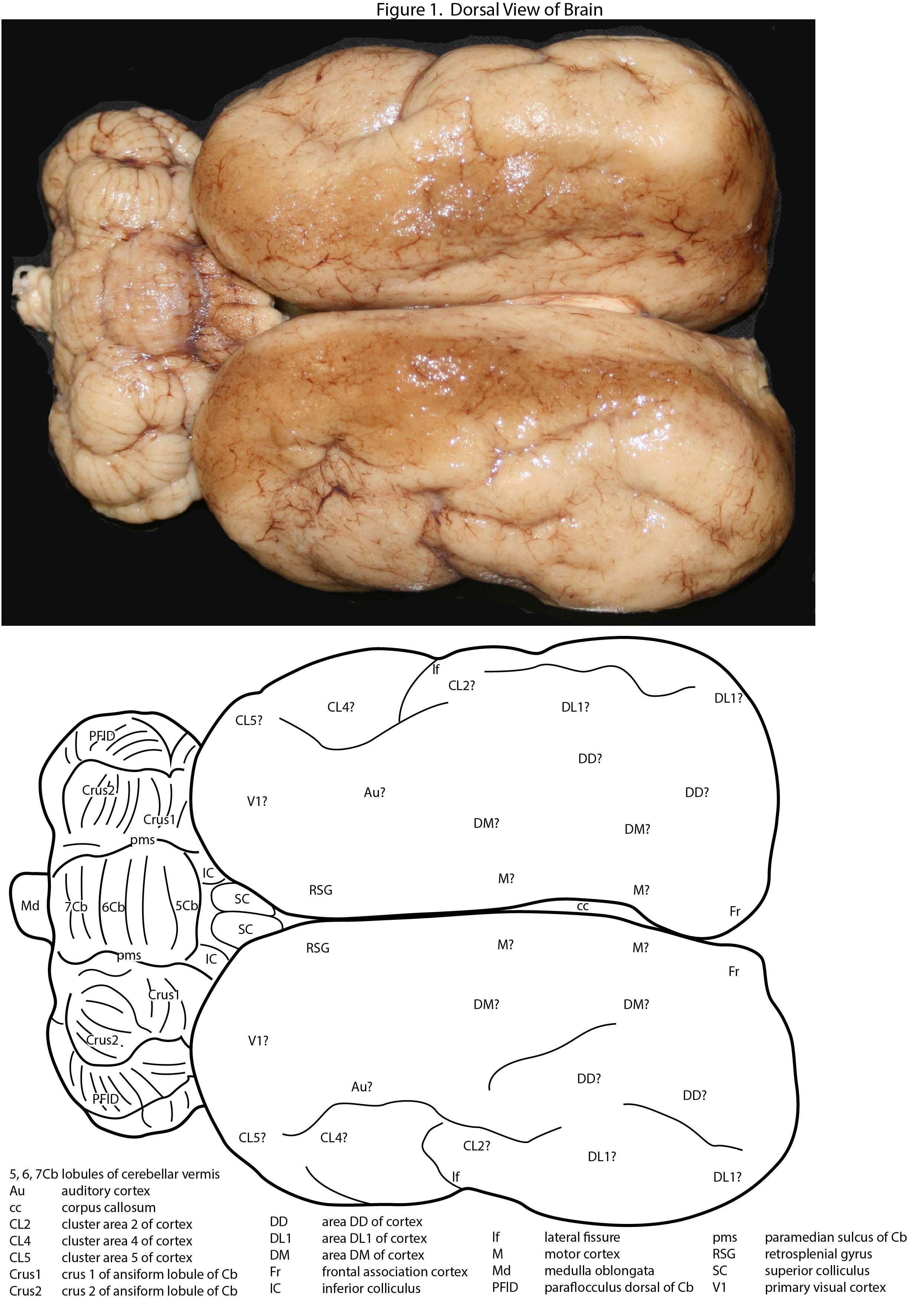
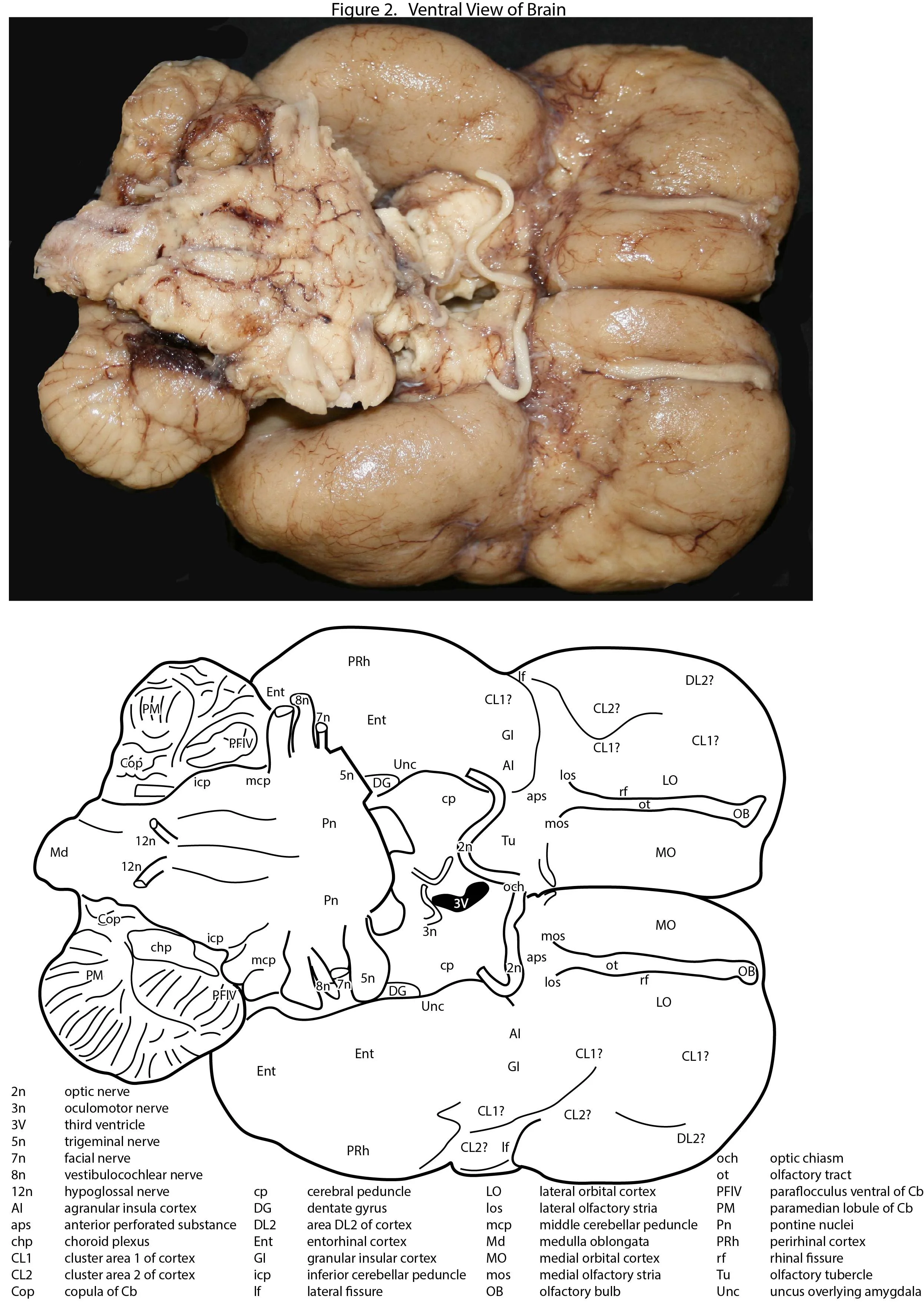
Figures 1 and 2 show the brain of the dugong in dorsal and ventral views, respectively. The brain weighed 265 g at autopsy and our MRI scans yielded a brain volume estimate of 240,462 mm3, giving a calculated density of the fixed brain of 1.10 g/ml. The brain is lissencephalic (smooth cerebral hemisphere), with only a very shallow lateral fissure (lf) and exposed insula (granular and agranular insula; GI, AI); the optic nerve (2n), olfactory bulb (OB) and olfactory tract (ot) are small, but the trigeminal nerve (5n) is large; and the cerebellum (Cb) has large hemispheres and a prominent primary fissure (prf).
References
Berta A, Sumich JL, Kovacs KM (2006) Sirenians and other marine mammals: Evolution and systematics. In Berta A, Sumich JL, Kovacs KM (eds) Marine Mammals Evolutionary Biology, 2nd edition. Academic Elsevier, San Diego pp 89 -110.
Domning DP (1982) Evolution of manatees: a speculative history. J Paleontol 56: 599-619.
McKenna MC (1975) Toward a phylogenetic classification of the Mammalia. In Phylogeny of the Primates (Luckett WP, Szalay FS eds). Plenum New York. pp. 21-45.
Pirlot P, Kamiya T (1985) Qualitative and quantitative brain morphology in the sirenian Dugong dugong Erxl. Z Zool Syst Evolut Forsch 23:147-155.
Rainey WE, Lowenstein JM, Sarich VM, Magor DM (1984) Sirenian molecular systematics - including the extinct Steller’s sea cow (Hydrodamalis gigas). Naturwissenschaften 71:586-588.
Seiffert ER (2007) A new estimate of afrotherian phylogeny based on simultaneous analysis of genomic, morphological and fossil evidence. BMC Evol Biol 7: 224.
Thewissen JGM, Domning DP (1992) The role of phenacodontids in the origin of modern orders of ungulate mammals. J Vert Paleont 12: 494-504.